
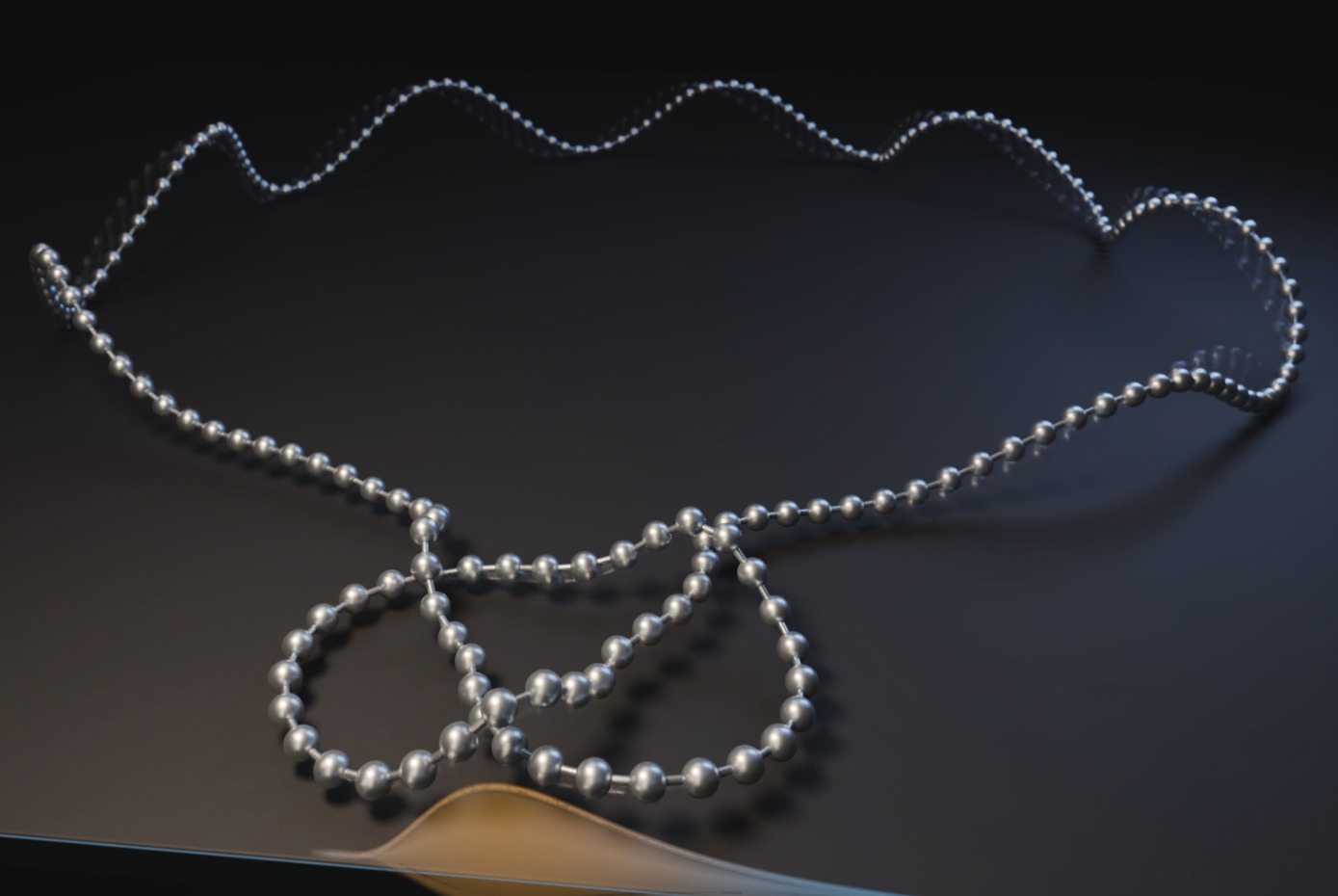
Can a knot tighten without anyone pulling on the chain? In our PNAS study, we placed a closed loop of metal beads on a vibrating table and watched a loose knot shrink on its own. As it tightened, fewer beads made up the knot core while the knot type stayed the same.
Watching a knot shrink
We filmed the moving chains and used computer vision to count the beads in the knot core frame by frame. In one experiment with a 211-bead loop, a loose trefoil tightened to about 32 beads in roughly 30 seconds. The knot continued to fluctuate, spending more time in compact shapes. We observed spontaneous tightening in all four knot types we tested.
Why entropy favors a smaller knot
Inside the knot, neighboring strands limit how a chain segment can move, as though it were confined in a narrow tube. When a segment slips out of the core, it has more possible configurations. This gain in entropy favors a smaller knot. Bending the chain more sharply costs energy, which limits how far the knot can tighten.
What equilibrium physics can explain
The vibrating table continually supplies energy. Even so, equilibrium Monte Carlo simulations and knot-tube theory approximately reproduced how often different knot sizes occurred. Looking at how the size changed over time revealed a small difference between the forward and time-reversed statistics, consistent with weak breaking of detailed balance.
A compact knot concentrates its crossings in a short stretch of chain. Whether spontaneous tightening helps topoisomerases resolve knots in DNA remains an open question.
Paper and videos
Qiyuan Qiu, Yujie Zheng, Jiansong Yang, Peng Hua, Yilong Han, and Liang Dai. Entropic tightening of knots in granular chains under vibration. PNAS 123 (45), e2615990123 (2026).